Skin Barrier Repair Mechanism Diagram
Build a clear skin barrier repair mechanism diagram covering SC lipids, ceramides, filaggrin/NMF, tight junctions, and TEWL recovery—ready for papers, claims decks, and education slides.
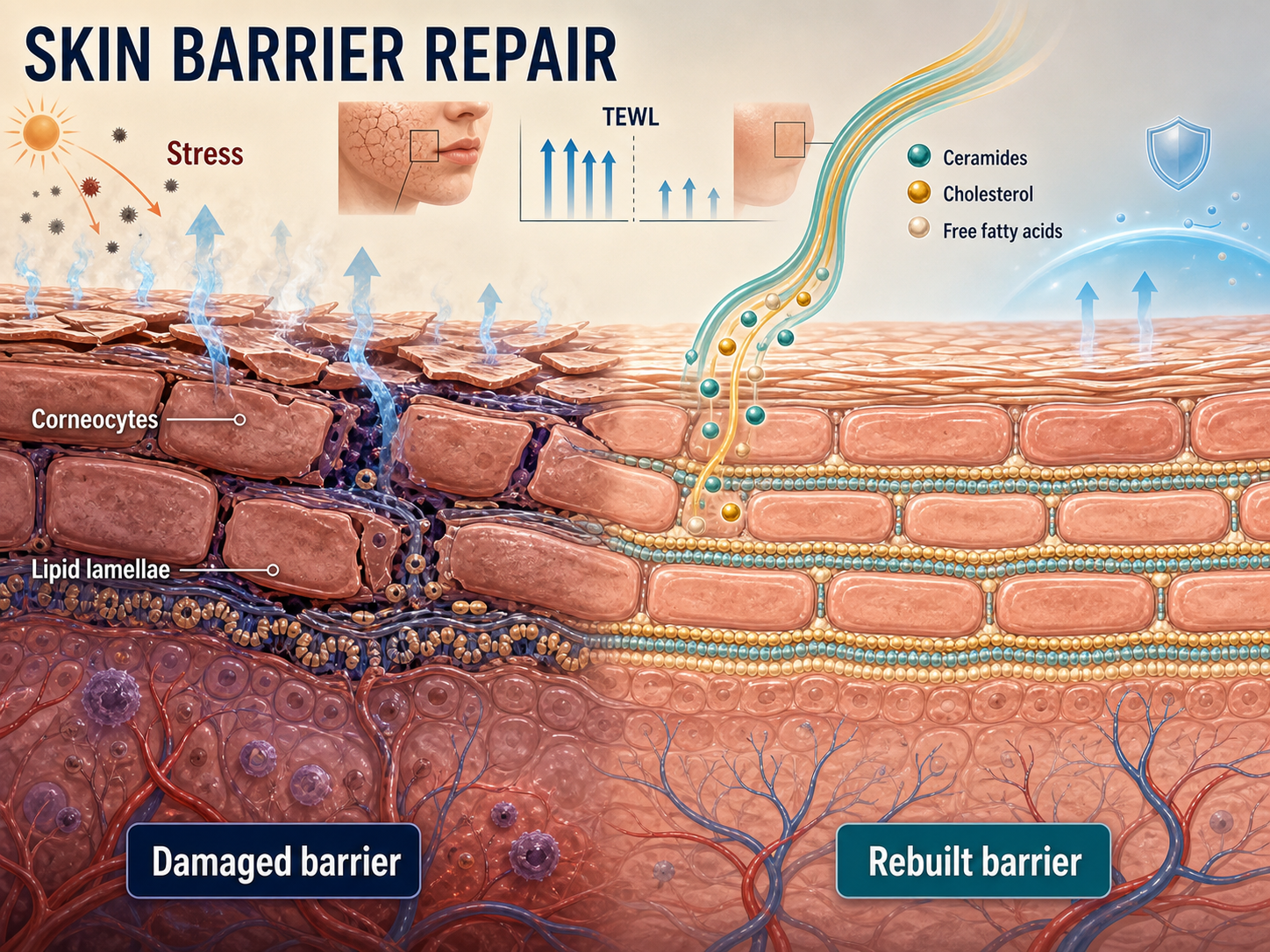
What this mechanism diagram shows
A barrier-repair figure should show the stratum corneum as a “brick and mortar” system, what fails when lipids or proteins are depleted, how TEWL rises, and where ceramides, cholesterol, fatty acids, or soothing actives restore structure and signaling—not only a pretty skin cross-section.
- 1Barrier insult damages SC lipid packing and/or protein structures.
- 2Lipid depletion and NMF loss increase TEWL and dryness signals.
- 3Tight-junction and inflammatory feedback can amplify barrier stress.
- 4Repair inputs (ceramides, cholesterol, FFA, soothing agents) rebuild the mortar and calm signaling.
- 5Endpoint: lower TEWL, restored cohesion, and improved tolerance to routine actives.
Why barrier diagrams convert search intent
Queries like skin barrier repair mechanism diagram come from formulators, medical aesthetic educators, and brand science teams who need a defensible schematic for TEWL, dryness, or post-procedure recovery stories.
Generic “healthy skin” art underperforms. Searchers want named structures (SC, ceramides, tight junctions) and a recovery arc they can put next to clinical or in-vitro talking points.
Recommended diagram structure
Left or top: barrier insult (surfactant, UV, low humidity, inflammation). Middle: lipid matrix disruption, filaggrin/NMF loss, tight-junction stress, rising TEWL. Right or bottom: replenishment (ceramide NP/AP, cholesterol, FFA), microbiome-friendly soothing, and restored barrier metrics.
Keep one consistent visual metaphor (brick–mortar or layered SC). Annotate 3–5 intervention points maximum so the slide stays readable at conference distance.
Generate and reuse in MechFig
Start from the prompt on this page. Swap the insult type and the hero active (ceramide complex, panthenol, centella, etc.). Export for PPT or keep iterating labels for a methods figure.
Pair with whitening or anti-aging pages only when the story truly connects (e.g., barrier-first routine before brightening).
Reusable prompt
Paste this into MechFig, then replace the ingredient, pathway, or target tissue with your own research context.
Cross-section skin barrier scientific diagram, layered epidermis schematic, simple icons for lipids, left-to-right or top-down flow, journal figure style, minimal text labels. Scientific content: Barrier damage → elevated TEWL → disordered SC lipids (ceramides, cholesterol, FFA) → inflammation. Repair: replenish ceramides → lamellar body secretion → lipid bilayer restore → lower TEWL.
Embed this mechanism diagram
Copy the HTML below to include descriptive image text and attribution back to this example page. Confirm that your use complies with applicable rights and site terms before publication or commercial use.
FAQ
What is the difference between a barrier diagram and a product shot?
A mechanism diagram names structures and steps (SC lipids, TEWL, repair inputs). A product shot shows packaging. Reviewers and search users looking for “mechanism” expect the former.
Which labels are essential for a ceramide barrier figure?
Stratum corneum, intercellular lipids (ceramide/cholesterol/FFA), TEWL, and at least one repair intervention. Filaggrin/NMF or tight junctions are strong additions when space allows.
Can I use MechFig for barrier mechanism slides?
Yes. Use this page’s prompt, specify your active and clinical endpoint, and generate a pathway or cross-section style figure suited to education or brand science decks.